Understand human workload and optimize performance
HF Designworks helps organizations measure, model, and manage human workload in complex systems.
We combine human factors expertise, workload analysis, human performance modeling, and real-time assessment to help teams understand when people are overloaded, underloaded, or being asked to perform work that technology could better support.
Defense & Government - UAS & Autonomy - Medical & Health - Complex Technologies
Human Workload Is a System Design Problem
Workload affects much more than how busy someone feels. When demands exceed human capacity, the consequences can include missed information, slower decisions, increased error, reduced situation awareness, degraded mission performance, and safety risk. Too little workload can create its own problems, particularly in highly automated systems where operators must remain engaged and ready to intervene.
HF Designworks helps teams understand these demands before they become operational problems. We evaluate workload in the context of the complete system: the tasks people perform, information they manage, decisions they make, technologies they interact with, environments they operate in, and the automation available to support them.
Real-Time Workload Assessment With FortiFly
HF Designworks has created FortiFly, a real-time workload assessment tool designed to help teams understand human workload as it changes during system operation and evaluation.
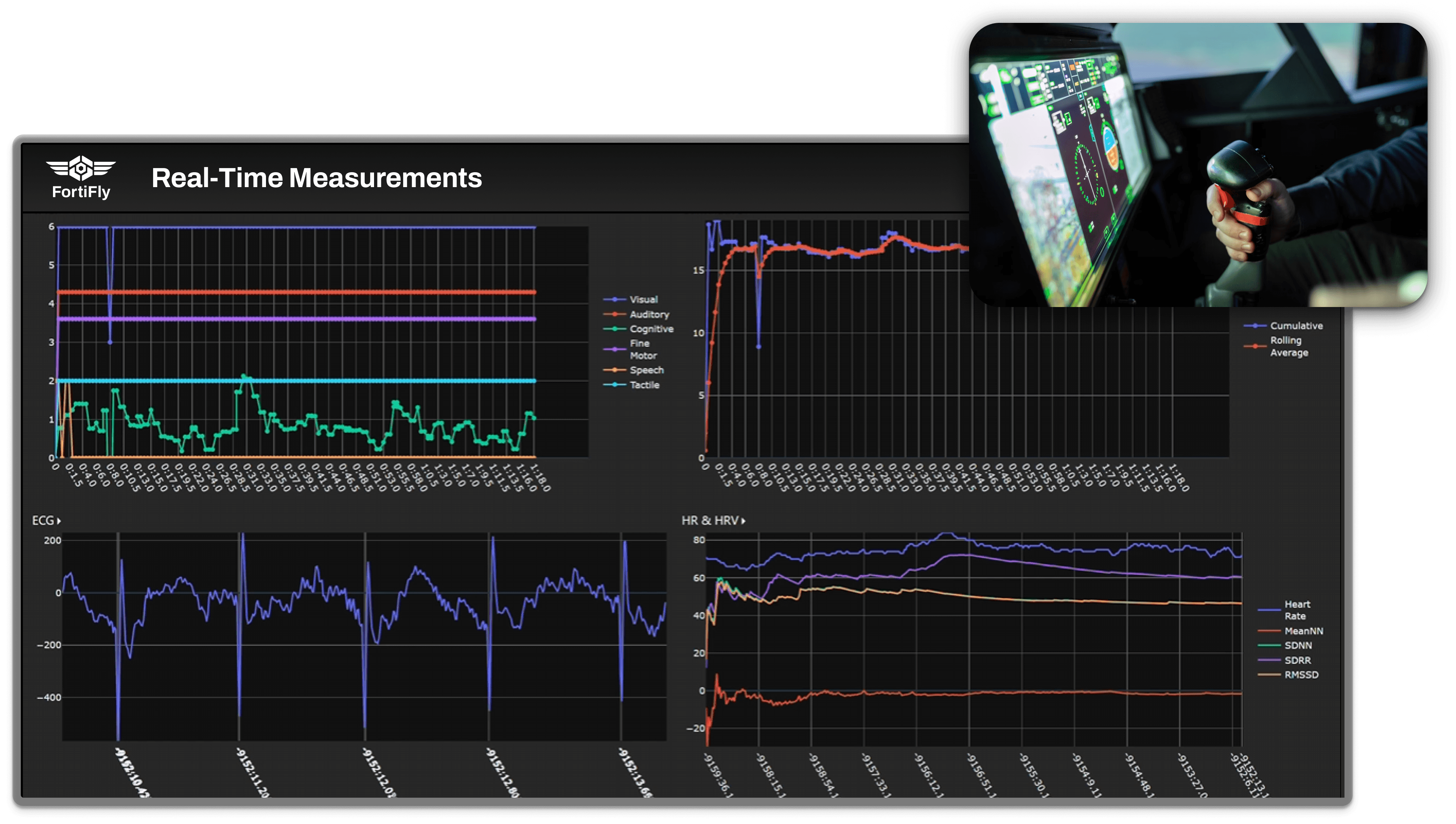
Traditional workload assessments often provide a snapshot after a task or test is complete. FortiFly supports a continuous, real-time view of workload, helping teams identify when workload changes and connect those changes to what is happening within the system or mission. This can be especially valuable during:
Human-in-the-loop testing
Simulation
UAS and multi-UAS operations
Training exercises
System evaluations
Prototype testing
Operational demonstrations
Automation and autonomy studies
FortiFly can complement traditional human factors methods and workload measures, providing another source of evidence for understanding how people are responding to system demands.
How We Can Help
HF Designworks has applied methods across aerospace and UAS systems, medical and health technologies, defense systems, software, and other complex technologies.
Real-Time Workload Assessment
Measure and assess workload in real-time as people interact with systems, perform missions, complete simulations, or participate in human-in-the-loop evaluations to reveal workload peaks, transitions, and operational conditions that may be difficult to identify through interviews or post-test questionnaires alone.
Workload Analysis
Identify where tasks, information, decisions, and environmental demands create excessive or uneven workload. We help teams understand not only whether workload is a problem, but when it occurs and what is driving it.
Human Performance Modeling
Model tasks, operator demands, mission timelines, and system interactions to evaluate how proposed concepts may affect human performance. Modeling allows teams to explore alternatives before committing to expensive system designs or operational concepts.
Staffing & Crewing Analysis
valuate whether proposed crew sizes and staffing concepts can support the required work under realistic operating conditions. We consider task demands, concurrency, workload peaks, automation, mission duration, and other factors that affect how much work people can successfully manage.
Function Allocation
Determine which tasks should be performed by people, automation, or a combination of both. We evaluate function allocation in the context of human capabilities, system performance, workload, mission needs, and the consequences of automation failure.
Human-in-the-Loop Evaluation
Use representative users, realistic scenarios, prototypes, simulations, and operational systems to assess workload and performance under conditions that reflect how the system will actually be used.
Why HF Designworks
01
Workload as a system design problem
We evaluate workload in the context of the full system—tasks, information, automation, staffing, mission demands, and operating conditions—rather than treating it as a standalone usability metric.
02
Deep experience with UAS and autonomy
Our team has co-authored UAS standards and understands the unique workload challenges created by multi-UAS operations, supervisory control, alert management, system monitoring, and increasingly autonomous systems.
03
Analysis that supports operational decisions
We help teams answer practical questions about staffing, crewing, task allocation, automation, alerting, and operator-to-system ratios so workload findings can directly inform design and mission concepts.
04
From measurement to better system decisions
Whether through modeling, human-in-the-loop evaluation, or real-time workload assessment, we translate workload data into actionable recommendations that improve human performance, safety, and system effectiveness.